Marketing is increasingly transcending the old funnel models into continuous, customer-centric growth models. The HubSpot Loop Marketing framework is a concrete approach that involves four key steps namely, Express, Tailor, Amplify, and Evolve. These four steps ensure that a company can attract its audience, tailor marketing for customer experience, scale up successful marketing campaigns, and continuously optimize marketing efforts. The process is enabled by integrating the above activities with the HubSpot CRM where the customers' data and insights can be used to facilitate more meaningful and valuable engagement with the customers.
What is HubSpot Loop Marketing?
Short Answer: Loop Marketing by HubSpot is a contemporary marketing philosophy that emphasizes the concept of sustained customer engagement rather than viewing marketing as a one-directional funnel. This philosophy helps organizations to attract leads, identify their needs, customize communications, amplify their successes, and constantly refine their strategies.
This strategy is carried out in four main phases, namely Express, Tailor, Amplify, and Evolve. All the phases are built on each other in the form of a cycle.
Businesses may leverage the HubSpot Marketing Hub to run campaigns, organize content, monitor engagement, and analyze the performance of their campaigns across all channels. An effective strategy of HubSpot CRM will assist you in connecting customer information in your marketing and sales efforts to provide visibility into the customer journey.
Furthermore, utilizing HubSpot marketing workflows will help you in automating your tasks, personalized communication, and follow-ups.
Unlike just concluding your effort after a successful conversion, Loop Marketing suggests that you learn from each of your interactions and apply the learning to your future campaigns.
How Does HubSpot Loop Marketing Work?
Marketing in HubSpot Loop takes place through a perpetual cycle, which consists of using information about customer interactions and performance to enhance marketing operations. Rather than ending the journey of the customer at the point of conversion, the process utilizes information gained throughout all stages to increase the relevance of the future marketing campaigns.
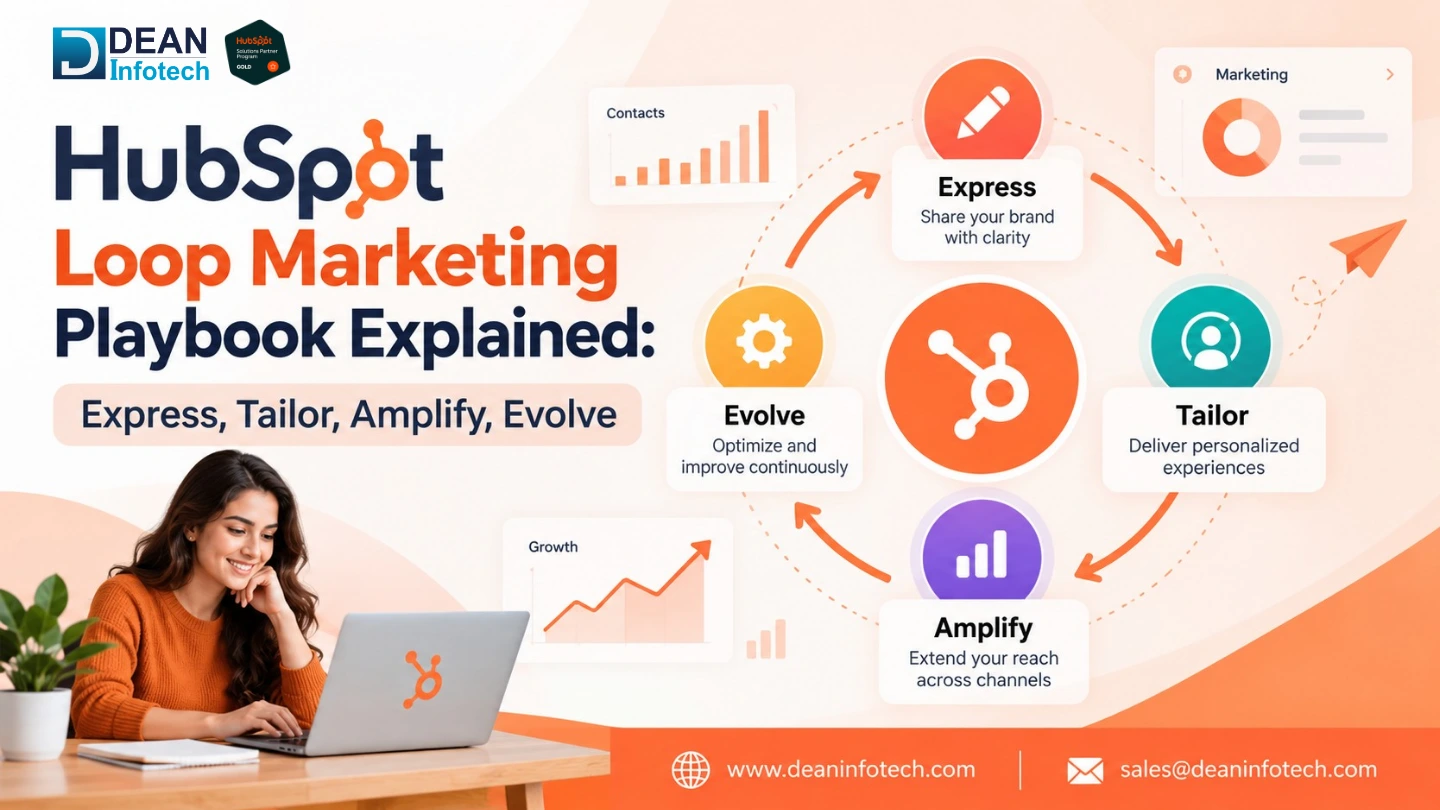
The process begins with articulating a message or campaign in a way that would attract the appropriate target market. Businesses are then required to customize their content and experiences according to customer interests and engagement.
When implementing HubSpot Marketing Hub, companies will be able to integrate campaigns, analytics, content, and customer data into one system. HubSpot marketing workflows allow marketers to perform tasks such as lead nurturing, email follow-up, segmentation, and personalized communications. With new customer analytics, the marketer will be able to develop a strategy and continue the loop process.
The Four Stages of HubSpot Loop Marketing Playbook Explained
The marketing playbook by HubSpot called "Loop" contains four interlinked phases – Express, Tailor, Amplify, and Evolve. These phases help to understand customers better, provide more relevant experiences, broaden successful activities, and improve the strategy all the time.
1. Express: Create a Strong Brand Message
The first step, known as Express, involves ensuring effective communication of the brand. For a business to achieve this, there is a need to come up with messaging that aligns with its value proposition and is suitable for the target audience.
This can be achieved through the use of HubSpot Marketing Hub which enables marketers to create and publish content through various channels including email, landing pages, social media, and blog posts. The objective is to ensure that there is a message that gets attention.
2. Tailor: Personalize the Customer Experience
Following the interaction between prospects and your content, the next step is to personalize their experience. It involves the use of customer information, their behavior, preferences, and interactions to deliver more relevant content and communications.
When HubSpot CRM is integrated properly, all the customer information is gathered. This enables the marketer to understand the stage of the customer and then use segmentation and personalization to communicate with the customer.
3. Amplify: Expand What Works
The Amplify stage is focused on campaigns and content that work and ways to scale them up. Instead of analyzing every campaign separately, marketers may check out the data on how well the campaigns performed and use the information to learn which campaign worked best for their target audience.
An excellent email marketing campaign might inspire posts on social media or a blog or some other nurturing campaigns. HubSpot marketing workflows will help with follow-ups and distributing the content at the right moment of the customer journey.
4. Evolve: Learn and Improve Continuously
The last one is called Evolve. It helps in implementing continuous improvement by analyzing performance and customer feedback. Marketers have an opportunity to analyze their campaigns, their engagement rates, conversion rate, and customer behavior to find out what needs to be adjusted.
In the framework of HubSpot Marketing Hub, teams have the opportunity to monitor marketing performance and use this knowledge for adjustments in their message, targeting, content, and workflows. In this way, they develop a continuous feedback cycle instead of just having one campaign launched once.
Thus, the cycle including such stages as Express, Tailor, Amplify, and Evolve allows creating a marketing cycle which is highly adaptive due to its flexibility.
Why Is Loop Marketing Important for Modern Businesses?
However, customer expectations keep changing, making it hard for companies to count on a static marketing funnel or one-time marketing campaigns. Continuous Strategy by HubSpot through Loop Marketing ensures that companies can learn from the interaction with customers and apply these insights to future marketing activities.
This approach advocates that companies focus on personalization, engagement, and optimization, rather than just leads. Companies can measure their performance and behavior in order to learn what works for them in terms of messaging, content, and other components of marketing.
Also, the strategy will ensure alignment of marketing approaches and customer journey. With the proper tools and processes in place, companies can deliver more personalized experiences for their customers, develop better relationships with them, and make more efficient use of their marketing data.
Keys to Success With Loop Marketing
HubSpot Loop Marketing can only succeed if there is continuous insight into your customers and using data to make sure you optimize your campaigns.
Customer Insights: To make your customers feel relevant and to provide them with personalized content, you will need customer insights and their behaviors.
Stay Informed with Updated Customer Data in CRM: You have to stay informed with accurate customer data in your HubSpot CRM.
Make Use of Marketing Actions: Use HubSpot marketing actions to nurture, follow up, segment and personalize.
Relevant Content: Create content that satisfies the needs and concerns of your customers.
Track Performance: Track the performance of your customers in your campaigns.
Continual Optimization: Continuously test and optimize based on the feedback you have gathered.
Stay in the Loop: Any engagement of your customers must be taken as an opportunity to learn and improve your marketing.
How HubSpot Plans Align With the Loop Marketing Framework
The plans provided by HubSpot can assist in meeting several aspects of the HubSpot Loop Marketing framework in accordance with the needs of the business marketing and level of automation. What is important in this case is to choose components ensuring continuous engagement, personalization, and optimization.
Express: The HubSpot Marketing Hub provides solutions that assist businesses in creating campaigns, content, emails, landing pages, and other marketing strategies.
Tailor: The HubSpot CRM provides solutions that allow businesses to manage customer data and use it to their advantage.
Amplify: Marketing automation, and HubSpot marketing workflows can help organizations build successful campaigns.
Evolve: Reporting and analytics provide information about the performance of the campaign, and at the same time, ways to improve it.
By implementing HubSpot CRM correctly, organizations will be able to combine all of the above elements and create a continuous marketing loop. This will mean combining data, automation, content, and analytics to move through the stages of Loop Marketing.
Loop Marketing vs. Traditional Marketing Funnel
The marketing funnels have always been based on linear principles that include attraction, conversion, closure, and then starting on to the next deal. But, on the other hand, HubSpot’s Loop Marketing strategy is an ongoing process where customer feedback determines future marketing strategies.
Traditional Marketing Funnel | Loop Marketing |
Linear customer journey | Continuous customer cycle |
Focuses on lead conversion | Focuses on ongoing engagement |
Campaigns often have a defined endpoint | Insights feed into future campaigns |
Limited post-conversion focus | Continues learning after conversion |
Relies heavily on predefined stages | Adapts to customer behavior |
Through HubSpot Marketing Hub, companies will be able to implement this continuous process through automation, personalization, analytics, and customer data. This way, marketing teams can shift from their funnel mentality towards a customer engagement process.
Conclusion
Loop Marketing by HubSpot is a continuous process in modern marketing through which the customer insight, personalization, automation, and continuous optimization is connected. These stages, namely Express, Tailor, Amplify, and Evolve, allow companies to create a relevant experience while continuing to learn from the customers’ interaction with their company.
Marketing Hub by HubSpot makes it possible for businesses to organize their campaigns, engage in them and measure their performance. An effective implementation of HubSpot CRM makes it possible to have access to the data of customers throughout the customer journey and thus to make proper marketing decisions.
Companies willing to implement or optimize such a strategy may get assistance from Dean Infotech in creating the corresponding HubSpot strategies, workflow, and CRM.
Need expert help with your next project?
Get expert guidance across Salesforce, HubSpot, GoHighLevel (GHL), AI, and web development — tailored to your business.








Comments