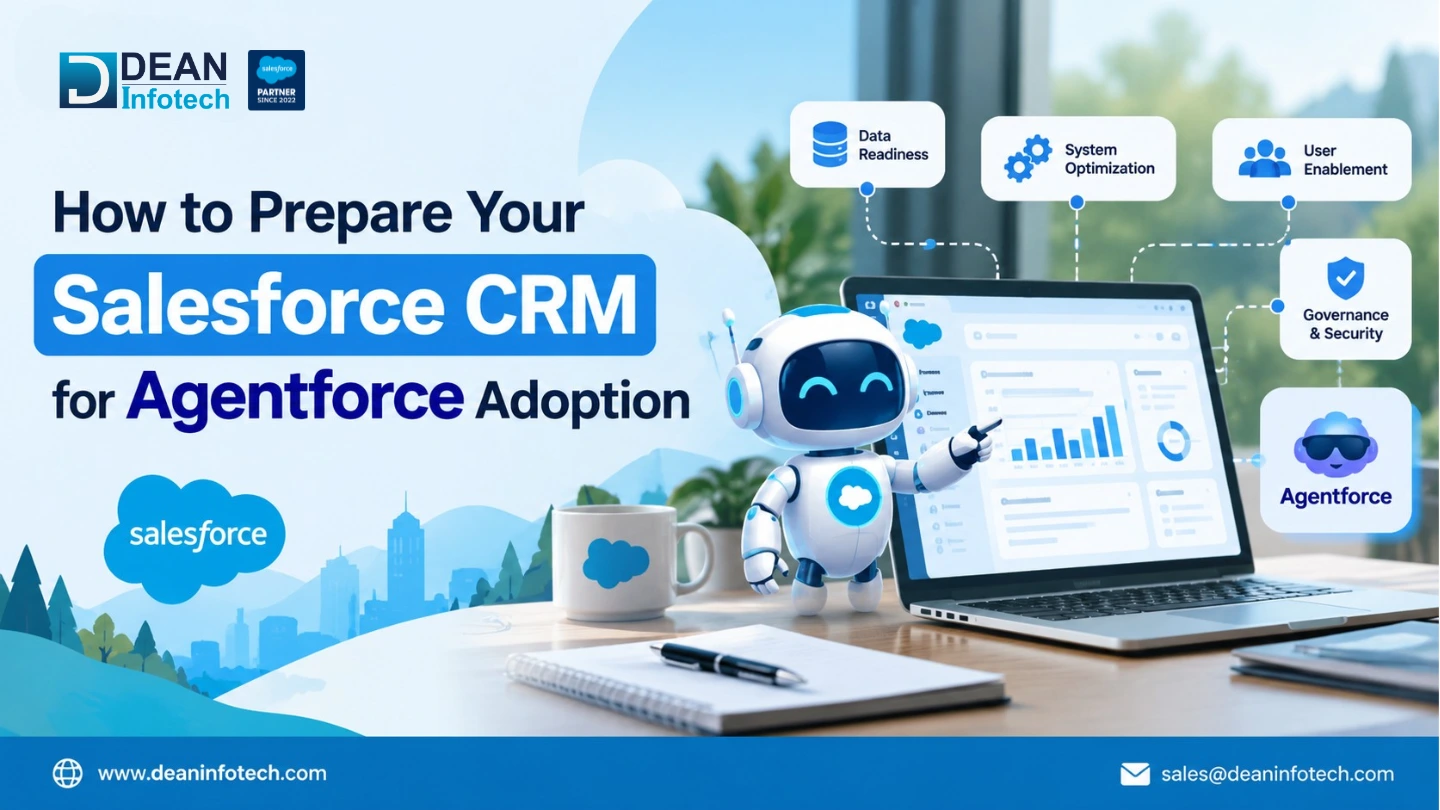
Agentforce provides organizations with an opportunity to automate their customer interaction, optimize their processes, and enhance their experience through Salesforce. However, before using Agentforce, a business should have a strong basis in its CRM. It is crucial for a business to know the quality of its Salesforce data and whether there is enough automation for an AI-driven workflow prior to implementing Agentforce.
Just activating Agentforce does not guarantee that you are going to get the results. Poor data, poor processes, poor automation, and problems with access may hinder the opportunities of an agent and create some unnecessary obstacles for implementing the product. Preparation of your Salesforce CRM prior to implementation will allow building a basis for implementing Agentforce.
Here is what you need to know about preparing your Salesforce CRM for implementing Agentforce.
What Your Salesforce CRM Needs Before Agentforce Adoption
Short Answer: The operation of Agentforce depends on the properly constructed Salesforce CRM platform of correct data, right processes, and automation controls. Agentforce operates using the data and actions offered by your Salesforce platform, thus, the issues in the configuration of Salesforce CRM may affect the efficiency of agent-based procedures.
The first step you need to do is to have correct and easily accessible CRM data. Data regarding the customers, accounts, leads, opportunities, and cases should be up to date, complete, and easily accessible. It is also true for the data of Salesforce objects and fields.
First, it is necessary to describe the processes before making them automated by using AI. Analyze your business processes, approvals, and automated processes and make sure that they match your requirements. In addition, check the user’s permissions and security requirements to ensure that the Agentforce has access to required information and actions.
The most important thing is to establish clear goals for business and use cases. Find out where Agentforce would meet a certain business goal, instead of trying to automate everything right away.
Before you begin:
Is your CRM data clean and accessible?
Are the objects, fields, and relationships clear?
Have the business processes been described?
Is there reliable automation available?
Are the user permissions set up?
Do you have use cases for Agentforce?
A good Salesforce Implementation Services and Salesforce Consulting Services audit will allow you to find possible holes before implementation.
Prepare Your Salesforce Data, Objects, and Processes
Prior to integrating Agentforce, consider the Salesforce system within which your agents will work. The effectiveness of Agentforce depends on the nature of the data and processes that go into it. Proper, full, consistent, and current Salesforce data is critical for efficient work of your agents. Prior to implementing Agentforce, review your data and processes for any duplications or inconsistencies, among other issues.
This process will start with the cleansing of duplicate, old or erroneous data, as well as the filling of any missing pieces of information from the customer database. This includes the standardization of the key fields' names to ensure consistency of the data. Then, custom objects and fields should be reviewed to see if they still apply and fit together with the necessary data for an agent's use.
Relationships between the objects must then be checked. The agent needs to work with CRM context, not stand-alone records. This involves checking account hierarchies, contact relationships, opportunities, case history, and other related data that can help the agent in their decision-making or actions.
It is also necessary to consider historical data. First, determine which historical records are accurate enough to support the company's current business requirements. Secondly, consider the information that resides in places other than Salesforce that could be important for the agent.
Finally, audit existing workflows, business rules, and automation. Get rid of any out-of-date or contradictory automation. Make sure that you document important processes before automating actions via agents. A well-structured Salesforce system is a good starting point for Agentforce to operate on business processes and data.
In case any organization needs help in preparing for their CRM, then Salesforce Data Migration Services can help them to consolidate and migrate their data, and Salesforce Managed Services and Salesforce Development Services can help them maintain their Salesforce environment.
Review Security, Automation, and Agentforce Use Cases
Once the CRM data and processes have been reviewed, analyze how Agentforce will interact with users, records, and existing automation. Before an agent is able to have access to any customers' or business information, the security of the system needs to be looked at. This entails reviewing user permissions, field level security, record access, and sensitive information to ensure that the agents are working within acceptable limits. In the Agentforce era, Salesforce lists security, user management, and data management as among the key administrator functions.
It is important to take a least privileged approach here by ensuring that the agents are provided with the minimum amount of access necessary to do their job.
Review of Salesforce Flows, approvals processes, business rules, and any other forms of automation are important as well. Identify areas where manual tasks can be automated using Agentforce but don’t replace a process that is already flawed.
The next step will require choosing certain and measurable Agentforce use cases. Rather than automating all processes for customers and sales at once, start with addressing a particular business problem. Examples of such use cases include customer service assistance, case summary, knowledge base assistance, lead qualification, sales assistance, and routine CRM tasks.
Define the output that is expected, the data to serve as input, actions an agent can take, and performance metrics for each use case. It is suggested by Salesforce that rather than deploying into production immediately, one should move from experimentation and needs recognition to experimentation and implementation.
Another opportunity for businesses to use existing processes more efficiently could be through Salesforce Automation Services.
Test Agentforce and Prepare Your Team for Adoption
Tests need to be done before incorporating Agentforce into the daily process. Start with the sandbox or whatever other controlled environment that you have, where you will test out the agent responses, actions, permissions, and business cases without disrupting any processes in action. Salesforce recommends the process of testing and evaluation to ensure agent reliability before deployment.
The tests should be performed using real-life use cases that you have chosen. Figure out whether the agent is capable of retrieving appropriate information, following the instructions, making appropriate actions, and responding appropriately to the lack of data. Test it using various permissions and cases when the agent cannot proceed and needs to stop the process or turn to people.
User acceptance testing is equally important. The Salesforce adoption framework starts from the experimental stage and proceeds to implementation to actual usage stages, when training, documentation, analytics, and user support become more relevant.
Train Salesforce users about what Agentforce can do, when it can be used, and when human input is required. Create feedback gathering processes that will help analyze the data and optimize agent workflows post-implementation.
Continuous improvement can be achieved by exploring the use of Salesforce Managed Services for your company's maintenance of the Salesforce environment, and Salesforce Consulting Services for implementation and adoption.
Plan Your Agentforce Implementation and Measure Results
After your Salesforce CRM is ready, you should outline the implementation plan for Agentforce. Define what business processes will be managed by your agents, what tasks require human intervention, and how the agent should interact with your current Salesforce workflows. A phased approach will give your team a chance to detect possible problems and adjust the process in advance before implementing Agentforce in other processes.
Outline measurable objectives for each use case that requires Agentforce. These objectives may vary depending on the type of application from decreasing time needed for case resolution, better response time, improved lead qualification process, decrease in repetitive administrative tasks, or better customer service performance. Defining such metrics in advance will give your team the ability to evaluate the effectiveness of Agentforce implementation.
Another important stage is defining ownership. Appoint team members who will be responsible for agent performance monitoring, feedback review, knowledge and data quality management, workflow or permissions changes. The adoption of Agentforce should be considered as a process, not just implementation.
Regular analysis of performance metrics, user feedback, and results achieved with agent's help will let your company improve Agentforce workflows in accordance with changing business requirements while keeping your Salesforce CRM reliable
Agentforce Readiness Checklist
Before moving to production, use this checklist to determine whether your Salesforce environment is ready for Agentforce.
| Area | Ready When... |
| CRM Data | Records are accurate, complete, and standardized |
| Data Structure | Objects, fields, and relationships are clearly defined |
| Processes | Key business processes are documented and consistent |
| Automation | Existing automation has been reviewed and is reliable |
| Security | User and data access is properly configured |
| Use Cases | Specific Agentforce objectives and success metrics are defined |
| Testing | Agents have been tested in a controlled environment |
| Users | Teams understand how and when to work with Agentforce |
If several areas are not ready, address those gaps before expanding Agentforce. This Agentforce readiness checklist provides a practical starting point for answering the question, “How do I prepare Salesforce for Agentforce?”
Conclusion
Preparation for Agentforce in Salesforce involves the creation of a CRM framework, and not AI. Having clean data, good object structure, correct processes, proper security, proper automation, and specific use cases make for a better implementation. User training and testing will ensure successful adoption of the framework that you have created. In case you need assistance in determining your CRM readiness or even implementing Agentforce in your CRM, Dean Infotech can provide you with Salesforce services.
Need expert help with your next project?
Get expert guidance across Salesforce, HubSpot, GoHighLevel (GHL), AI, and web development — tailored to your business.







Comments