Professional services firms involve a number of repetitive functions, such as handling client communication and documentation, preparation of reports, and coordination of projects. With AI Automation, these companies are adopting a new way of dealing with their day-to-day activities, which involves minimizing repetitive processes and improving the efficiency in processing information. Rather than wasting many hours doing administrative duties, professionals can automate these processes using AI so that they can be more productive. With increased customer demands for quick and personalized services, many businesses have adopted AI automation services in order to boost their efficiency and enhance scalability of their business operations.
What Is AI Automation for Professional Services?
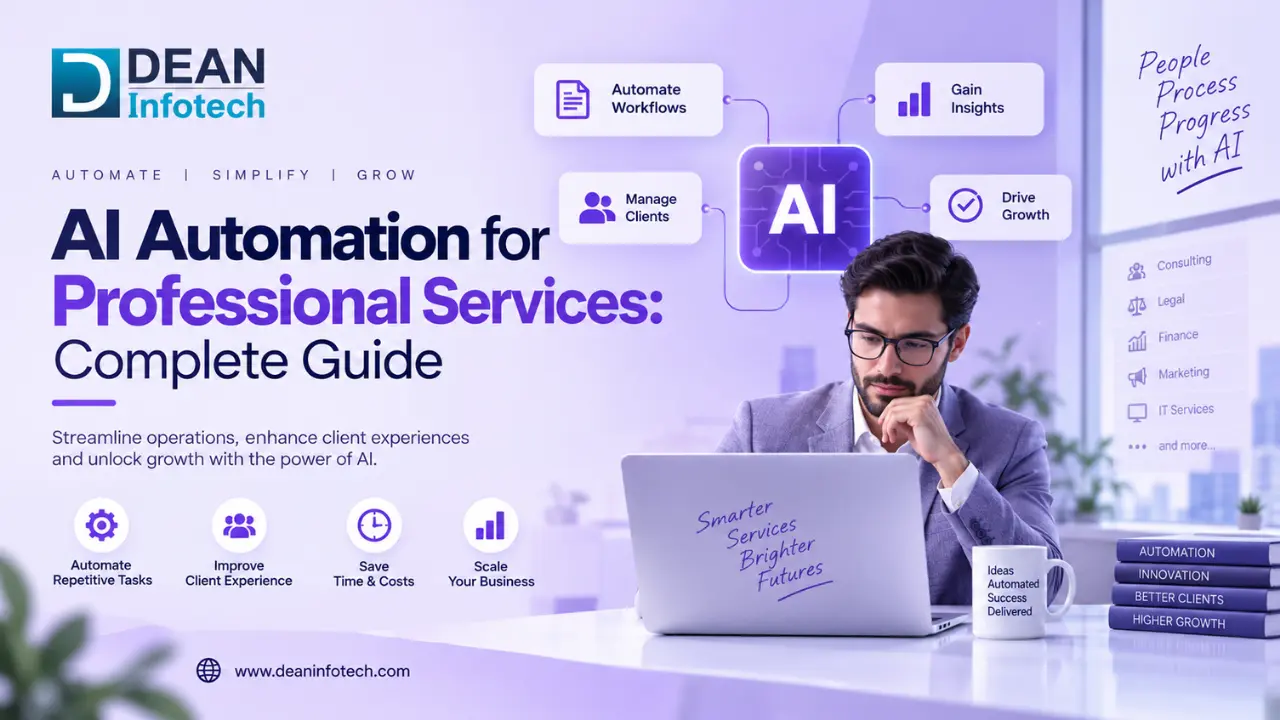
Professional service automation using AI involves the use of artificial intelligence to process repetitive and time-consuming business procedures, which are based on rules. This automation utilizes AI together with the already existing process of work to assist firms in managing activities such as communications, documentation, analysis, scheduling, reporting, and follow-ups.
Unlike the previous automation that was mostly based on pre-defined rules, AI-based systems are capable of processing information, identifying patterns, generating outputs, and adapting accordingly. Therefore, professional services automation is capable of evolving from mere task automation to more complex workflows involving consulting, accounting, law, marketing, and IT services.
AI Agents Services is another way companies may use artificial intelligence to build smart digital workers capable of completing multi-step operations and interacting with corporate systems as well as helping the employees during their day. Done correctly, AI automation will increase productivity while letting the professionals concentrate on dealing with clients and earning money.
Which Professional Services Tasks Are Best Suited to AI Automation?
Automation via AI is most suitable for the activities that professionals perform in their services practice when such activities are repetitive in nature, take a considerable amount of time to complete and require dealing with huge volumes of structured or unstructured information.
Client interaction: AI can compose emails, answer FAQs, compile notes, and automatically send reminders to facilitate better communication with clients.
Document processing: The AI system is capable of extracting valuable information from diverse document types such as contract documents, proposal documents, invoice documents, etc.
Data Entry & Processing: Diverse activities such as data entry, data verification, data classification, and data update can be done using AI in an accurate manner.
Research & Analysis: AI is capable of processing enormous amounts of data, finding valuable patterns, creating summaries, and assisting in research.
Scheduling & Coordination: AI can arrange appointments, plan meetings, assign tasks to others, and remind people about future events.
Reporting and documentation: AI can generate business reports and documentations from data available in the company.
Lead and customer processing: AI can qualify the leads, update the database in CRM, personalize contacts, and find future follow-ups while interacting with customers.
Project management: AI can monitor deadlines, compile summaries, spot any risks or delays, and inform team members about upcoming tasks.
On the other hand, it should be understood that there are some professional service activities which should not be completely automated since there are some situations which need to be under human control. The ideal thing would be for organizations to automate repetitive tasks while maintaining the involvement of the professionals where necessary.
What Are the Benefits of AI Automation for Professional Services?
Automation with AI can help professional service organizations make their day-to-day tasks easier and increase efficiency by enhancing the customer experience. Organizations can integrate professional services automation with artificial intelligence technology to minimize the time spent on performing monotonous tasks and spend more time on those tasks which demand expertise.
Increased productivity: AI can be used for carrying out mundane activities for the management which will allow the staff to focus on more client-oriented and strategic roles.
Reduction in costs: Automation of the process can reduce manual effort, reduced use of resources, and increased efficiency.
Faster service delivery: Professional services with AI can make processes such as research, handling documents, reporting, and communication with the clients much faster.
Manual error elimination: Since automation of process helps eliminate errors that may occur because of repetitive data entry and information processing.
Client-friendly service: Faster responses, personalized approach, and follow-up can help create strong client relationships.
Scalable process: With the help of AI Workflow Automation, the firms can take on more work without having to scale their administrative effort correspondingly.
In general, the mechanization of AI helps professional service firms in creating efficient processes and enabling their employees to concentrate on addressing complex problems and decision-making.
What Does AI Adoption Look Like in Professional Services Right Now?
The deployment of AI in professional services has moved from merely experimenting with AI to its deployment in everyday activities. Professional service providers are increasingly applying AI to perform functions ranging from researching, reviewing documents, analyzing data, creating content, interacting with clients, and internal information sharing. Instead of eliminating jobs, most companies are relying on AI to help professionals and eliminate repetitive work processes.
The usage of generative AI is also increasingly becoming part of business operations. Professionals can use AI to generate summaries of meetings, write reports, analyze data, and even generate the first draft of an intended report or letter. Advanced companies are embracing AI-driven workflows and intelligent agents to automate several processes across business platforms.
However, not all companies are at the same point in terms of AI adoption. Companies providing professional services should consider privacy, security, accuracy, compliance, and human involvement aspects before adopting more AI technology. Generally speaking, the success of AI adoption starts with certain low-risk processes where AI can have some effect.
With the ongoing evolution of AI technology, the emphasis is gradually shifting from using AI to strategic implementation of AI.
What Are the Most Common Mistakes Firms Make with AI Automation?
Even if AI automation increases efficiency, there may be a few challenges that professionals may face when integrating AI without proper planning. In this way, companies can achieve success in their ventures by not falling into the following traps.
Incorrect automation: Rather than optimizing the process first, companies may end up automating a process that isn’t efficient or even overly complicated.
Automation of everything: All activities do not require AI to be implemented. Things such as tough judgment calls or decisions need to be done manually.
Data security issues: Professional services companies collect private client data which makes data security very important when choosing an AI solution.
No reason for implementation of AI: It is not wise just to go along with the crowd and implement an AI just because other companies have done so. The company needs to define what their issues are before proceeding.
No verification of data: Information provided by the artificial intelligence software may contain inaccuracies. This data needs to be verified before its usage.
Lack of proper preparation of employees: The staff of a company needs proper training on how to use AI software.
The approach adopted in AI automation should be characterized by applicability, security, measurability, and the integration of skills of artificial intelligence and human capabilities.
Conclusion
AI-based automation is one of the key tools for enhancing productivity and making routine tasks less cumbersome for professional services companies, while also providing better service to clients. Whether it is document handling, research, communication, or reporting, proper AI technologies can make a great difference in terms of streamlining processes, while letting professionals concentrate on high-value activities. To succeed in this, companies will need clear goals, proper workflow security, staff training, and correct human oversight. Dean Infotech assists companies in identifying and implementing effective AI automation solutions based on their specific business needs.
Need expert help with your next project?
Get expert guidance across Salesforce, HubSpot, GoHighLevel (GHL), AI, and web development — tailored to your business.









Comments